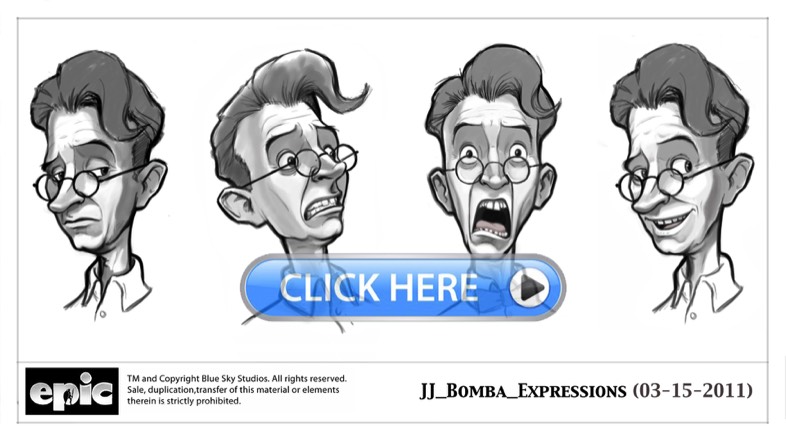
Prior to full-blown production starting on a feature, work was done by a small crew of animators to get things to a point that once the entire animation crew joined the team, they would hit the ground running. During my career at Blue Sky I regularly participated in the pre-production process. I always liked this kind of work because I enjoyed working on small teams, the variety of work, and It gave me an opportunity to use my drawing skills. Work would include rig testing, character draw-overs, expressions, art directed phonemes, animation tests, etc. Hand-drawn animation tests were beneficial to the process, because we were able to make cost-effective decisions on things without having to get modelers and riggers involved. I would work on performance test that were used to define an animation style for the feature or a specific character. Or they could be simply to decide how unique character should move or its mechanics could work.
Performance Test
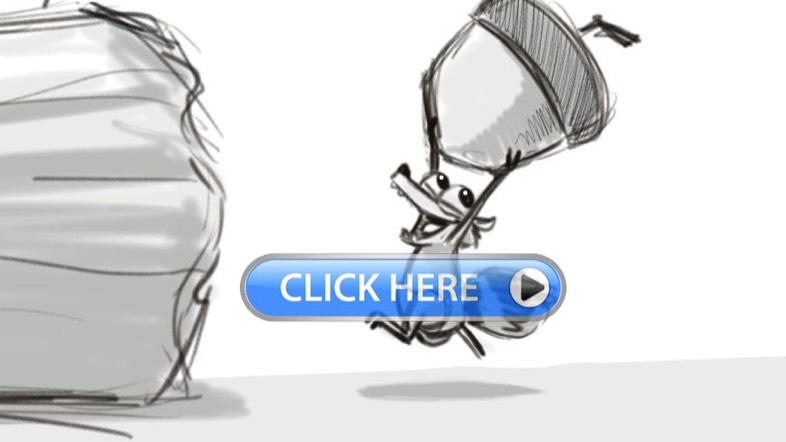
This test had a unique purpose. I did this animation while I was on a small team of 4 artists developing the idea for the "Scrat Tales" series on Disney+. The point of this animation was to show the Disney executives the relationship that we envisioned between Scrat and Baby Scrat. The concept was that when the two were together, they would have a loving parent child relationship. However, once the acorn appeared, they became fierce competitors, but Baby Scrat would always end up with the acorn in the end.
My only work on "Ferdinand" was during the preproduction process. These were simple mechanics tests that I shared with the rigging team. Riggers at Blue Sky were amazing, and there was no limit to what kind of controls they could provide on an animation rig. By me doing these tests, we were hoping to communicate with them some of the specific controls we would be looking for. Also, the film's director, Carlos Saldanha had a vision for a very simplistic line of action on the Bull. Part of these tests were to explore his vision.
Expressions
Storyboarding
Rig Notes
Draw-overs were a great way to visually communicate with riggers.
I did not do this very often, but while working on Epic my animation director came to my desk and said they were struggling with the "puff" blend shape. He asked me if take a pass at it. I tried few drawings but I wasn't happy with what I was coming up with. So I ended up doing a paint-over instead